No matter the setting, the interior never seemed to exceed roughly 300 degrees. Bake element tested weak under an actual load. Replaced, holds temperature accurately now.
Peregrine L.
Uneven baking, a slow preheat, or a dark display all tend to come down to one component, not a reason to replace the whole appliance.
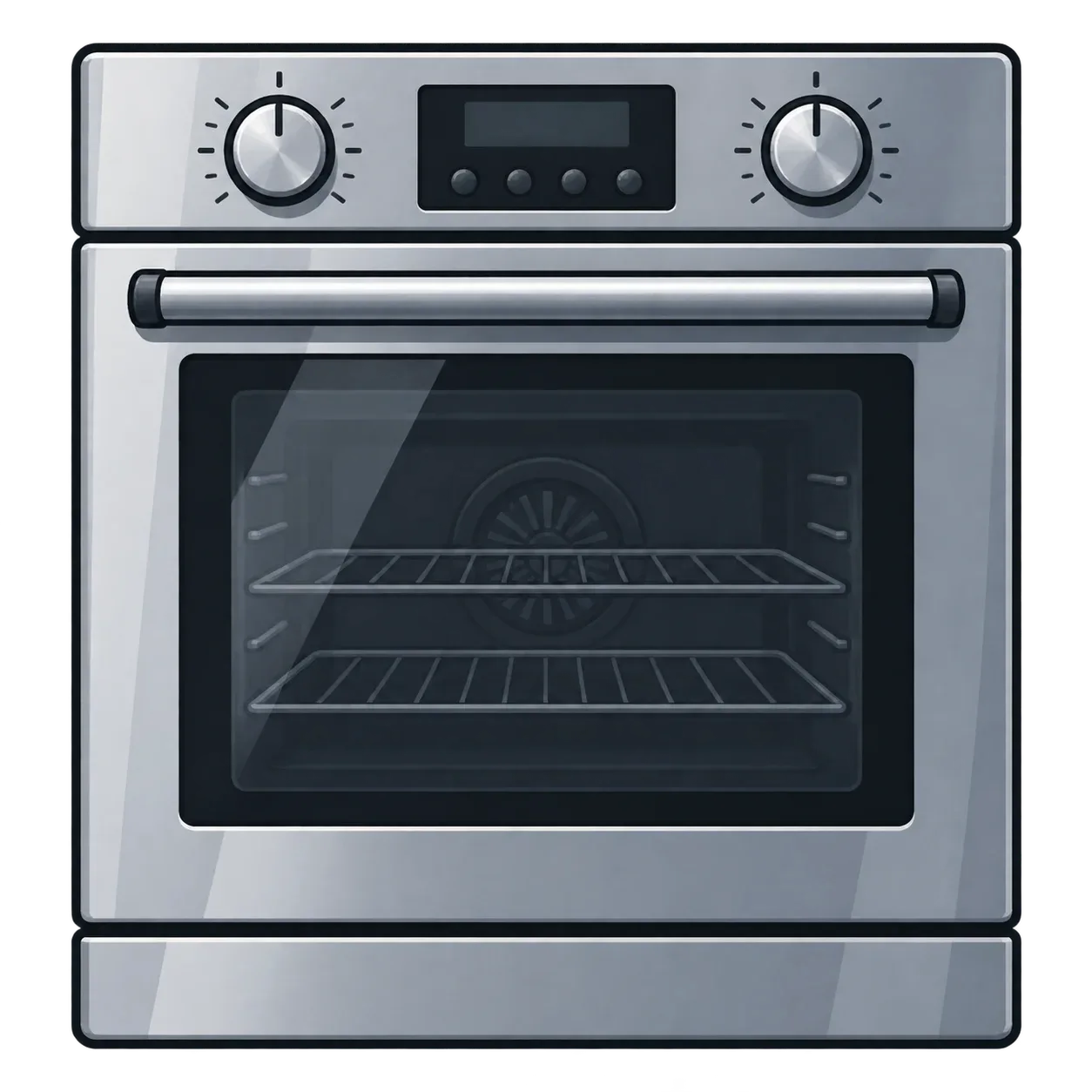
Open any of these for a plain explanation of what's usually going on.
Set it to 375 and whatever's inside just doesn't finish the way it should, undercooked or pale past when it ought to be done. On electric models, a bake element that's only partly working is the common explanation, something we confirm by running it under real load instead of a visual inspection. A weakening igniter does the same on gas models. We measure output rather than assume.
A preheat that once finished in ten minutes now drags toward twenty or beyond before the oven's ready. This usually happens gradually rather than all at once, whether that's a gas igniter losing strength or an electric element quietly fading. We track heat across the whole preheat window, since a single reading misses this kind of slow slide.
Even with a tray positioned dead center, one side consistently ends up darker than the other. A stalled convection fan often explains this, since without moving air the heat has no way to distribute itself evenly across the cavity. An element with a weak spot somewhere along its length can do the same. A test bake maps out exactly where it's going wrong.
Hold a hand near the door while it's running and you'll feel warmth escaping, even though it looks fully shut. Usually a gasket that's lost its shape, or hinge tension that's loosened just enough to leave a gap. Both parts get inspected together, since fixing just one when the second is equally worn usually leaves the problem only half solved.
Nothing registers when you press a button, screen's gone completely dark, no backlight at all. Far more often than a failed board, it's simply a connector behind the panel that's worked itself loose. We check that connection first, since reseating it is a quick fix when that's the actual issue.
The cycle stops or throws an error partway through, sometimes with the door stuck shut afterward and no apparent way to open it. Usually the door lock switch fires out of the exact order the board's programming calls for, and the board interprets that mismatch as a safety concern. Testing that exact sequence directly is more reliable than forcing a reset that may not actually stick.
Still Not Sure What's Wrong?
A quick call gets you a real answer, most jobs are wrapped in a single stop.
We work on these every week, not just occasionally, so we know what usually fails.










Codes vary by brand, but these patterns show up across most major oven manufacturers.
Control board or a temperature sensor fault has been logged.
Cavity temperature has gone past its safe upper limit.
Temperature probe reading is well outside the expected range.
Self-clean lock is engaged and hasn't released.
Power cut out briefly, clock will likely need resetting.
A control panel key is stuck or not responding.
Since every brand assigns these codes a little differently, use this as a rough starting point rather than an exact match to your owner's manual. If the same code shows up again after cutting power for a minute, get a technician out to read it correctly.
What customers said after we sorted out their oven.
A few oven complaints trace back to something small worth checking yourself, no tools required.
Use An Oven Thermometer
An inexpensive one tells you whether the real interior temperature lines up with what the dial claims. A gap larger than roughly 25 degrees is worth flagging when you call us.
Feel Around The Door Seal
Run a hand around the edge while it's heating, checking for escaping heat. A flat gasket is usually an easy fix.
Check Power Or Gas Supply
Electric models, check the dedicated breaker. Gas models, confirm the valve is fully open.
Rule Out A Locked Self-Clean
If the door refuses to open, first rule out whether a self-clean cycle is still in progress or simply hasn't finished releasing the lock.
Clean Out The Racks
Grime buildup can keep them from gliding freely, which gets mistaken sometimes for a hinge or door problem instead.
Reset Breakers After A Storm
A partial power dip can affect the board without a full outage, reset and check the display.
Still acting up? Something deeper is probably going on. Have a technician take a look and we'll figure it out.
We'll Handle It
859+ jobs done, a 90-day warranty on every one, and a $0 diagnostic fee once you go ahead with the repair.
Give us a few details and expect a call back to confirm a time.
Thank You!
Your message has been sent successfully. We'll get back to you shortly.
Thank You!
Your message has been sent successfully. We'll get back to you shortly.
Prefer to talk it through? (972) 812-7786